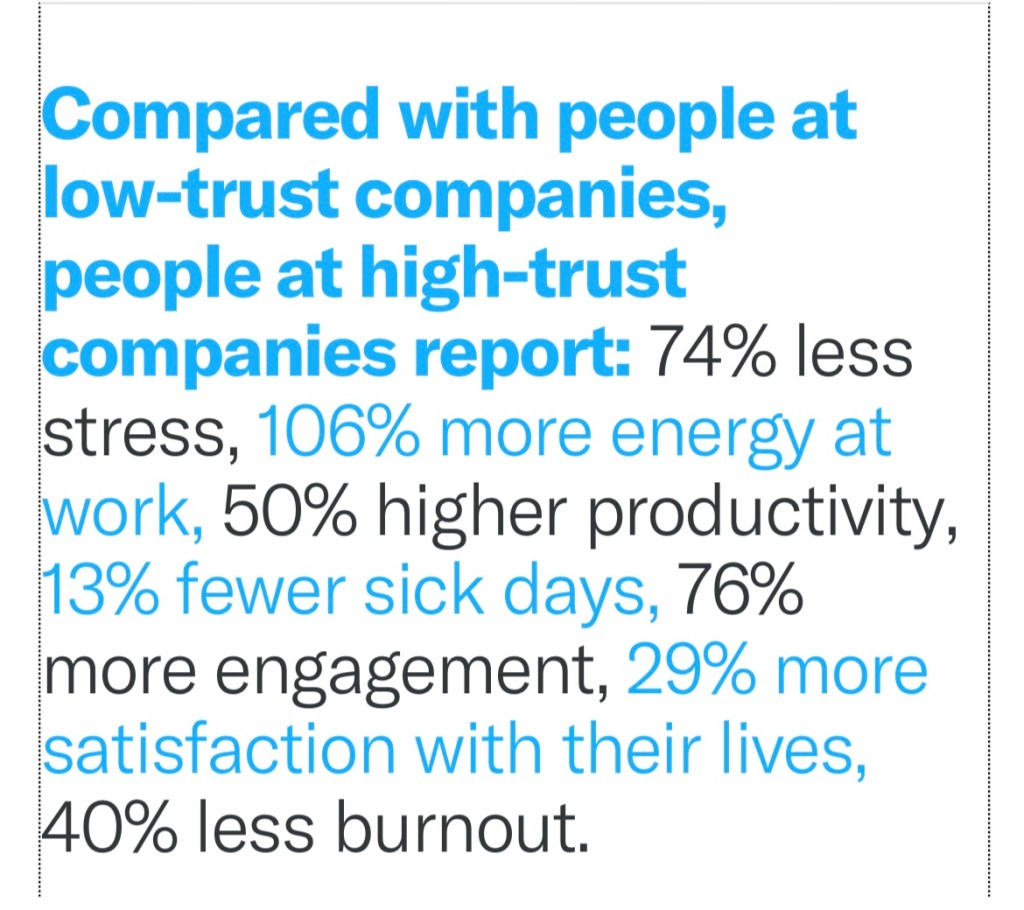
Trust seems to be the essence for success in modern organisations. Especially for agile organisations or the ones that are on their way of becoming one. The article in HBR “The Neuroscience of trust” made that very clear by showing some numbers.
It’s the task of every leader in an organisation to foster trust. To be a leader isn’t bound to a job title or a certain level in hierarchy. A leader is someone who decides for her or himself that a certain part in his/her world needs her/his support.
What can a leader do to foster trust? There are multiple ways to do that. Getting to know each other better is the first step. A wonderful exercise is to draw so called „Influence Maps“. „Where are you local?“ is another one and there are many more. In time you will see how people share more and more of themselves. Making yourself vulnerable with given these personal informations ads to the process.
Active listening and powerful questions lead to a style of communication that allows deeper understanding. As someone that studied Communication Science I know that understanding is not the norm. Radical constructivism says that the recipient always interprets what is being said through the lens of personal experience and cultural background. Given that full understanding is nearly impossible. But it’s possible to narrow this communication gap.
Mutual learning as described by Roger Schwarz helps to take a personal stance in this communication effort. The ground assumptions help to be open for new ideas and points of view, the ground behaviours help to have productive conversations.
All of this and more is needed to foster trust. Only in high trust environment can change thrive that is created by many not the few and that will play out for the benefit of the customer, the company and it’s employees.
 tomzigan.de