“We want to experience agile, but we only know a little about it yet. We’re 50 people and we have about 3 hrs time.”
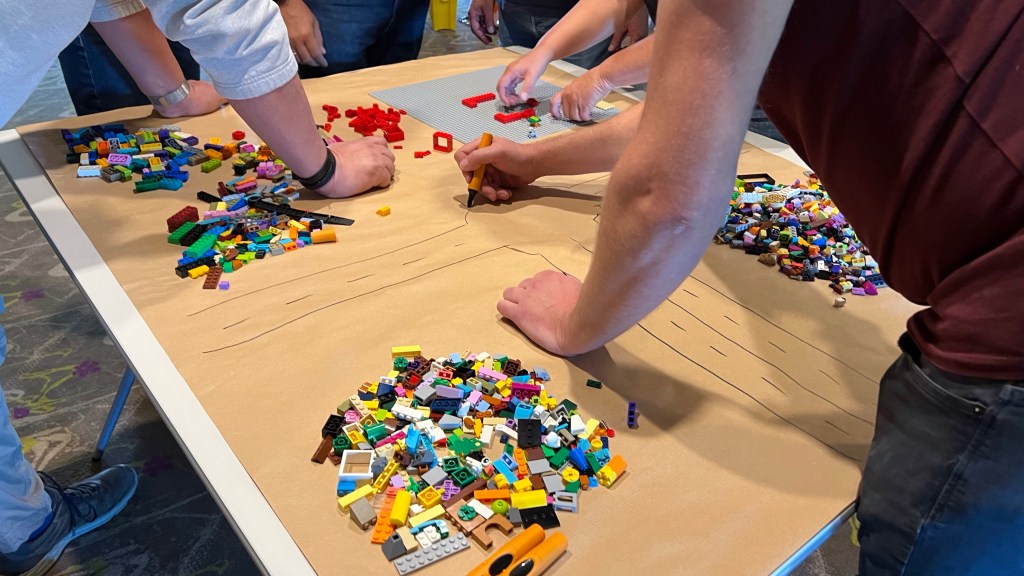
Lego4Scrum was invented by Alexey Krivitsky who wrote a book about it. It was the base for this 3 hour workshop. In this book he describes how you can build a Lego®️ City within a Scrum simulation.
I started the workshop with: Why? Why Agile?
To answer that question I turned to the Taylor Bathtub, which makes it pretty clear that agile is the answer to a challenge organisations face, not because the things that they have done till now are suddenly bad, but because the environment that they are competing in has changed. In a complex world the needed answers can only be given by a learning and therefor adapting organization.
Second step: The Agile Manifesto
It worked like a charm against the perception that agile was just a fad. Which is a common way to see Agile in late majority or even lagging organisations. Although the participants (including me) didn’t look like the had any clue about the latest fashion. 😉
Shortly after that I explained Scrum – which can be drawn by the way on a beer mats – and Inspect and Adapt as a core principle of agile. This intro had to be enough, because we wanted to build a city until the end of the workshop.
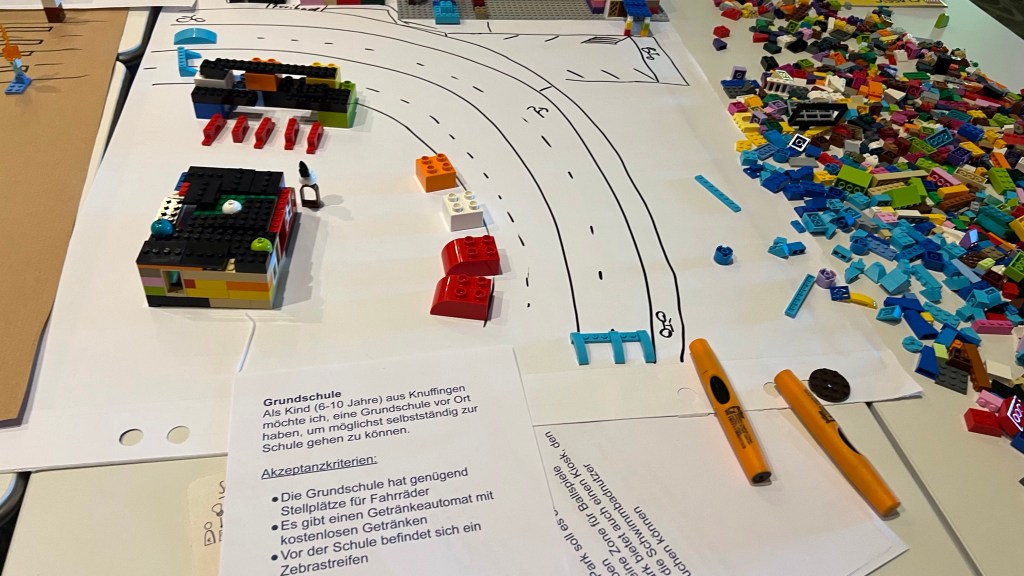
To gain some time I had prepared a Product Vision and about 40 User Stories with 1-3 acceptance criteria. I found some examples for user stories for Lego4Scrum simulations in the internet, but I wasn’t happy with them, so I rewrote them for my purposes.
Selforganised the participants created 5 teams. My acceptance criteria: equal number of participants, a PO and a Scrum Master. Next time I would go for one more team, because with 8 people in the dev-team not everyone was building all the time.
In total we had 6 of the Lego®️ Classic 10698 boxes, which turned out to be enough.
My learnings:
A challenge was to build up some pressure during the sprints. Because the sponsor wanted a light playful time for his employees, I hadn’t prepared metrics. Next time I would a least measure what was planned and what each team had really build.
The same problem was with the sprint duration. Because nobody looked at the timer, they didn’t really feel the time ticking. Next time I would work with more acoustic signals.
Because of certain constrains I was the only trainer. Next time I would rather go for two trainers when working with 50 people. Another option could be to brief the POs upfront accordingly. Because it turned out that they tended to accept everything their team had build, and played it nice.
One of the most effective moments was after the first sprint, when the models only stood on the table of each team. I shouted: “Where is my city?!” (I was so loud – it even surprised myself.) They learned that this was a group effort and that integrating the models showed other problems that without this interference they only would have noticed at a moment late in the building process when it would have been probably too late.
Another great moment was switching to a shared Review after the first Sprint Review, because now the developers really understood the big picture.
Altogether this was a successful workshop. I only regret that I couldn’t build stuff with them, because I really love to build things with Lego®️.
 tomzigan.de